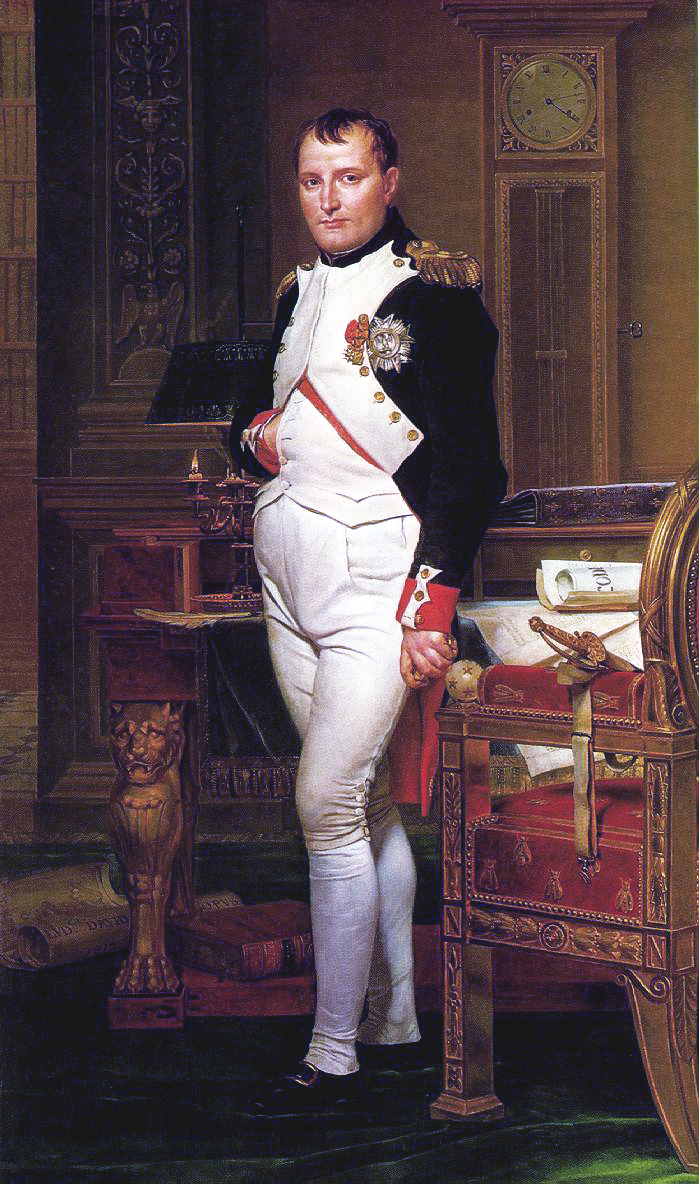
On 15th August 1769, Napoleon Bonaparte was born in the town of Ajaccio, on Corsica, a year after the island became a French territory. The wealth and political influence of his family enabled him to be schooled in mainland France. Initially he attended a religious school in Autun, then the military academy at Brienne-le-Château and finally the prestigious École Militaire in Paris where he trained to be a artillery officer.
In September 1785, Bonaparte became a second lieutenant in La Fère artillery regiment. During the early stages of the French Revolution, he returned to Corsica on an extended leave of absence, where he commanded a volunteer battalion in support of the radical revolutionaries. In 1793 Bonaparte published a pamphlet in favour of the republican cause which secured for him the support of Augustin Robespierre, the younger brother of the Revolutionary leader.
This patronage resulted in him being given the command of the artillery during the siege of Toulon, which British troops occupied. In recognition of Bonaparte's role in the successful assault on the city, the Republican authorities promoted him to Brigadier-General and gave him command of the artillery in the French army on the Italian border. Nevertheless, he spent a short time in prison in August 1794 following the fall of Robespierre due to his relationship with his brother.
After being released, Napoleon returned to military service but remained out of favour, losing his position as a general. Fortune smiled on Bonaparte again in 1795 when he took command of the forces defending the Republican government during a royalist uprising. In gratitude the new government, called the Directory, promoted him to Commander of the Interior and gave him command of the Army of Italy.
Successful campaigning in Italy brought Napoleon both fame and political influence. He then undertook a colonial expedition to seize Egypt and disrupt British access to India. The campaign proved to be a failure and Napoleon left an army ravaged by disease to return to France, where in 1799 he took part in a coup and became one of a number of provisional Consuls that ruled France.
Napoleon outmanoeuvred his fellow consuls and secured his election as First Consul for Life, effective becoming dictator. During a period of peace following the Treaty of Amiens, Bonaparte set about reforming the administration of France and repairing the infrastructure. During this period both Jacobins and Royalists plotted his overthrow, which gave him the excuse to revive the hereditary monarchy with himself as Emperor of the French. Bonaparte also placed his family and friends on the thrones of European states conquered by the French during the Revolutionary Words, including having himself crowned as King of Italy.
In 1805 the British persuaded the Austrians and Russia to join a coalition against the French. Napoleon gathered an army at Boulogne to invade Britain, but after failing to achieve naval dominance in the Channel he sent this Grande Armée to march into Germany. While the British dominated the seas, Bonaparte's army enjoyed a string of successes across Europe forcing the Austrians to sign a peace treaty. The British then formed a new coalition including Prussia but the dominance of Bonaparte's armies again resulted in the defeat of the continental powers, which he forced to join his Continental System to boycott British goods in a form of economic warfare. When Portuguese would not join the boycott Napoleon sent an army to invade Portugal with the support of the Spanish in 1807.
The Peninsular War marked the turning point in his fortunes as the English and Portuguese armies commanded by Arthur Wellesley, later the Duke of Wellington, drove the French back. In 1809, Austria broke its alliance with France opening a second front and further weakening the French. When the Russians failed to comply with the Continental System, Napoleon led the Grande Armée to invade Russia.
The disastrous campaign and humiliating retreat undermined Napoleon's rule. Following a series of further defeats and the capture of Paris by the Coalition, the Marshals of the French army confronted Bonaparte and forced him to abdicate. While peace negotiations took place between the French and the Coalition countries, Napoleon travelled into exile on the Mediterranean island of Elba. Napoleon retained the title of Emperor but his empire only comprised the island and its twelve-thousand inhabitants. After a failed suicide attempt Napoleon took charge of Elba creating a small military force and modernising the island.
After hearing that the Coalition were about to send him into exile on a remote Atlantic island, on 26th February 1815 Napoleon escaped captivity on Elba with around six-hundred men, arriving in France two days later. The 5th Infantry Regiment intercepted him at Grenoble, but rather than taking him into custody they acclaimed his as their Emperor. The return of Napoleon was similarly welcomed across much of France and he soon wrested the reigns of power away from the restored Bourbon monarchy.
With the loyalty of the senior army officers re-established, Napoleon marched in triumph into Paris on 19th March. After another series of constitutional reforms and mobilisation of the armed forces, he again took France to war against a new Coalition in a pre-emptive strike. His defeat at the Battle of Waterloo and his consequent surrender finally ended his reign. This time he was exiled on a remote island in the South Atlantic called Saint Helena, where he died in May 1821.
Related postsCisalpine Republic created: 29th June 1797French Protestants granted freedom of worship: 8th April 1802Louisiana Purchase Treaty signed: 30th April 1803Prince Murat executed: 13th October 1815
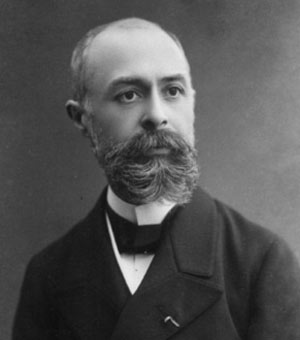 Born in Paris in December 1852, Henri Becquerel followed the family trade and became a scientist. His father, Alexandre-Edmond Becquerel, and his grandfather, Antoine César Becquerel, discovered the photovoltaic effect and both contributed to scientific knowledge about luminescence and phosphorescence. Both Alexandre-Edmond and Antoine César occupied the chair of applied physics at the Muséum National d'Histoire Naturelle, and in 1892 Henri followed suit.